
Brad Jackson
by Connor Greer
from Vol. Nos. 2 & 3
I was eighteen, and my parents were being psychotic, so I moved to Albany to stay with this guy Donny from my World of Warcraft guild. Donny was five years older than me and deaf, and he told me through private message that he had a spare room in his basement I could stay in. When I got there, it turned out the basement was actually his mom’s, and he was also living down there, collecting disability checks, and his mom was collecting them, too, for her back problems, and I didn’t have any income at all, so that made me the maid.
Donny stayed in the basement playing World of Warcraft all day and taking bong rips, and his mom stayed upstairs, on the couch, watching what was on TV, and also taking bong rips, and they didn’t communicate with each other, except when Donny’s mom banged on the floor with a broom because Donny was being too loud, which he couldn’t hear but could sometimes feel the vibrations of.
They stored garbage bags filled with trim in the closet and so the house was always held in the grip of an odor neither dry nor damp. Their bongs were disgusting, black with burnt, crusted residue. I tried to clean them with hydrogen peroxide and a carton of Q-Tips, but I scrubbed so hard that the peroxide splashed onto the floor and stained it white like some kind of shroud.
Donny’s mom had three large dogs which ran around all over the place. I don’t know what breed they were, but they were big. She said they were house trained. That was true some of the time.
I spent most of my days with Donny in the basement, playing World of Warcraft, running raids. We smoked and played with the curtains over the window slits that marked the border out of the subterranean, Donny’s laugh bubbling out of his mouth like a fountain, wheezing out from his throat in long gulps.
We had already played everything that was in the game at that point. Now, we were trying to do it faster, better, cleaner, to move up the leaderboards, to get better gear, to move even higher up the leaderboards. The guild leader, Cody, lived somewhere in Indiana and sent out a schedule every week.
When Donny’s mom was hungry, she gave me cash, and I walked down to the corner, to either the McDonald’s or the Arby’s, and that was when we ate.
It went like this for a while before a letter came from the landlord. The letter said that Donny and his mom hadn’t paid rent for months and that eventually, which was to say soon, we would be evicted.
Donny went downstairs and turned the computer on. I wrote out questions for him on a piece of paper, about what was going on, about the rent, and what we were going to do, and I pushed it in front of his face, but he wouldn’t look away from the screen.
He had told me they owned the house.
The next day, I decided to go out and look for work. I don’t know why. I didn’t have any illusions about my prospects. I hadn’t finished high school, and I wasn’t a hard worker. But it was like, in that instant, when that letter arrived, I became someone with a purpose, someone with something to live for, where before I had just been someone who was barely alive at all. I didn’t want to go home.
It was winter in Albany. All I had were three layers of hoodies. I walked, and my nose turned clown red, my glasses fogged up, but still I stopped in every business I came across and asked them if they were hiring.
The McDonald’s and the Arby’s wanted resumes. The Starbucks and the UPS Store drug tested. The guy at the gas station asked me what I’d do if someone came in with a gun, and I said I would give them whatever they wanted.
By the time the sun set, I had resigned myself to smoking a joint and eating McDonald’s on a bench in the strip mall across from Donny’s mom’s house, on the other side of the boulevard, in front of a store called Big Time Sports, which sold used sporting goods.
The guy behind the counter saw me smoking and came out. He was a big guy. Bald. He looked a bit like a naked mole. He said his name was Al and that that was his store, and he looked at me like I was supposed to understand that there was something else he was saying that he wasn’t actually saying, but I didn’t understand what that other thing was, so I said my name was Brad Jackson, which it wasn’t, but that was what I said, and I said it looked like a cool store, and I offered him the joint. He thought this was really funny. In fact, he told me how funny it was, he said I was a funny kid, and he asked me if I was looking for a job.
Mostly, I sat behind the counter and scrolled on my phone. There weren’t many customers. Al kept his office in the back. The walls were papered over with magazine spreads from Hustler. He paid me in cash. It was minimum wage, but he didn’t put anything in writing, so it was probably less. I never did the math. I knew it wouldn’t be enough to live on even before I started.
Al’s friend Greg stopped by the shop sometimes. He was even bigger than Al. They almost looked like brothers, or maybe cousins. Greg wore sweatpants, a Buffalo Bills sweatshirt, and large, diamond-studded sunglasses. Al said he knew Greg from high school, that Greg had been an NFL player for a while, that he’d played for the Bills. I guess that was why he wore the sweatshirt. Greg’s hands, especially, were enormous, like he could crush a human skull with his fingers, the forehead against his palm.
Whenever Greg showed up, he went straight to the back office, and he and Al sat back there. They didn’t come out for hours. I never heard them talking. I don’t know what they did.
I smoked in the alley behind the shop every forty-five minutes. I drank energy drinks, Monster and Rockstar. I bought them from the gas station. When I came home, it was strange—I found I was so exhausted from sitting on my phone all day that when, before I would have played World of Warcraft with Donny and the guild, I instead started to sit up with his mom, on the couch, and watch The History Channel or The Shopping Channel, taking bong rips until I felt like I was in a warm bath.
The landlord banged on the door one evening, while Donny’s mom and I were bathing. She didn’t get up from the couch, but I did. I looked at him from between the blinds. He was probably in his sixties. A gold chain over his polo shirt. White hair sticking out between the buttons. We didn’t answer. He left.
Sometimes the dogs shat long wet ropes all over the carpeting, and I had to pour baking soda down and scrub at it when I got home from Big Time. I remember one of the dogs, maybe the same one that liked to shit upstairs, got downstairs at one point and ransacked the basement while I was wiping at the smears, and it turned out that Donny had started pissing into old soda cups and that the dog had knocked over the cups, so I had to go down there and dab at that stuff, too.
I figured maybe the dogs would be less of a problem if I started walking them. There was a small park around the corner from Donny’s mom’s house. It wasn’t a nice park, just a block of grass overlooking some sad, beat-up houses, but I went over there with the dogs and let them sniff around and I smoked a joint and looked up at the sky and there were ten thousand layers of different things up there and all the clouds were all moving all at once.
The landlord came again, after dark this time, and he banged on the door, and this time, when we didn’t answer, he went around the side of the house and threw our trash cans around and shouted things I couldn’t make out. I was scared he would try to force his way inside or that maybe he had a key, but he didn’t—or he didn’t use it.
Al asked me the next day if I was looking to make some extra cash. I told him I would do anything. He said his friend Greg had a job for me, said that Greg would pay me well, but that I should be careful, and he handed me a card with an address on it. He told me I should go there after work.
The houses in Greg’s neighborhood were spaced very far apart, like little kingdoms. It was a long walk, and my body was shivering by the time I arrived. Really, they just looked like suburban houses, and Greg’s house was just a big house, just like all the other ones. The bushes were overgrown in the front and one of the garage windows card boarded over. The basketball hoop didn’t have a net.
The sizes of the windows were different on the different floors. They were smallest on the top floor, which gave the house the impression of being much taller than it actually was, or maybe it was the other way around. I can’t remember. I pressed a doorbell next to the ornate front gate, and a light flicked on. I saw myself reflected back at me in a camera above the intercom. The gate unlocked. I walked up to the house and rang a second doorbell, and the front door also opened on its own. I entered a long hallway. Framed posters of Greg as a Buffalo Bill lined the walls. As I walked down the hall, I saw that he had signed each one. There was a tropical-looking tree in a large marble pot at the end. The tree had died, and the fronds were shriveled and brown. Life-sized sculptures of lions sat on either side of it, their eyes winking red stones.
Everything was quiet. All the lights turned off. I stood in the hallway, waiting. I paced back and forth. I rubbed my shoulders, tried to warm myself. I wondered whether I’d gotten the time right, whether I was in the right house. Whether this had been a mistake. Eventually, I gave up and wandered around the house.
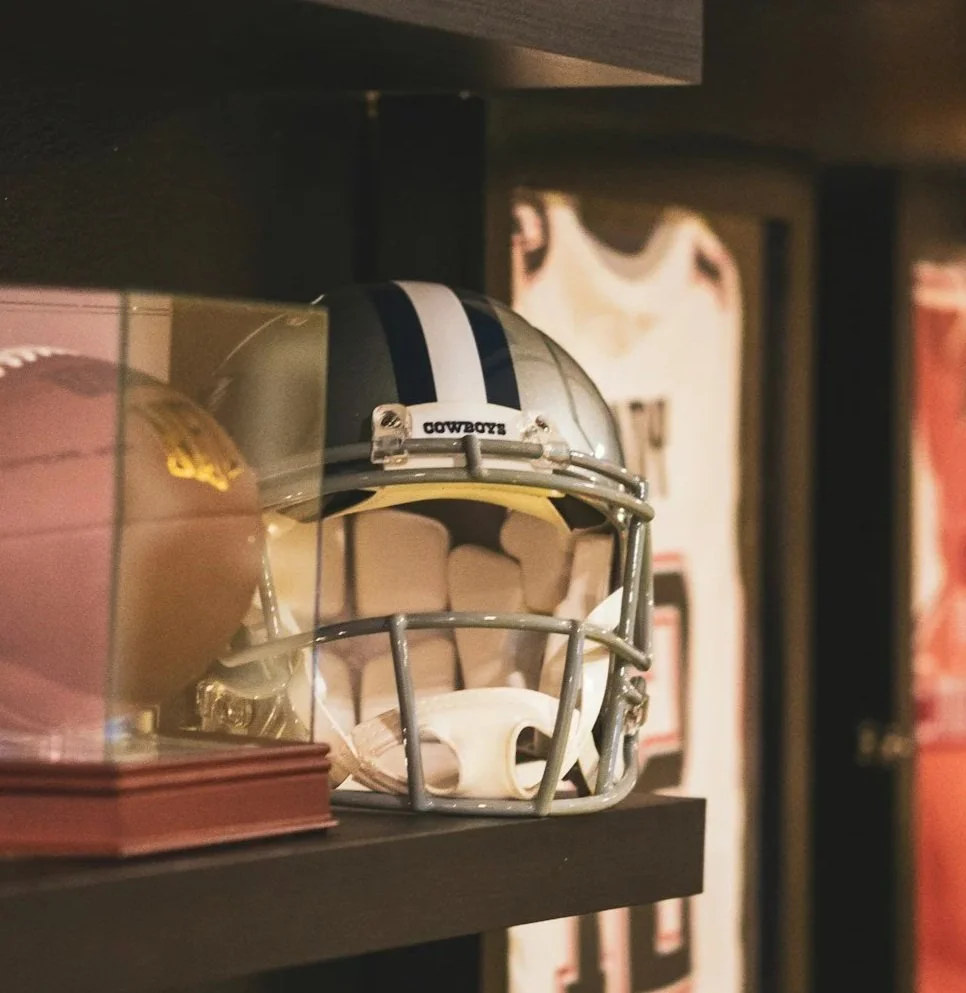
A chandelier hung over a dusty glass table in what I guessed had been intended to be the dining room. It didn’t look like anyone had ever eaten in there. In one corner was a pedestal with three Super Bowl Rings arranged on the top—one from the Cowboys, one from the Patriots, and one from the Broncos. I’d read Greg’s Wikipedia page, and I knew he hadn’t won any Super Bowls, so he must have bought them online somewhere, the rings from ball boys or something like that. In another corner, there were game balls signed by Joe Montana and John Elway mounted on wooden plates. I don’t think he’d played with either of them either.
The room across from the dining room was filled with powered off pinball machines. A Star Wars machine, an Indiana Jones machine, The Twilight Zone. These also looked unused. The dreams of a child from an earlier generation. Past the machines, a bookcase, each shelf filled with different styles of sunglasses, all studded with diamonds. I imagined Greg standing where I was standing, deciding which ones to wear.
The pinball room looked out over a pool, which was empty and scattered over with leaves and bits of trash.
I descended the central staircase, which was kind of a spiral, down into the basement, and entered into a large windowless room with a billiards table in the center and a built-in bar on the far side. I ran my fingers along the felt of the table and turned right into another room—an in-home movie theater with three rows of La-Z-Boy recliners, shag carpeting, acoustic panels lining the walls, and there, sitting in the first row, his face illuminated by the light of the screen, was Greg. A projector played an NFL game against the front wall. Greg had a gas mask over his face. He was laughing so much that he wheezed. The gas mask was attached to a tank with a plastic hose, and Greg opened and closed the valve which connected the tubes to each other, coaxing out and then silencing a whining flow of gas. His cheeks were wet. His eyes glistened.
On the screen, the football players attacked each other like gorillas or bulls. The quarterback flicked the ball thirty yards over the heads of the linemen. The announcer said it was because of the block, the block on number fifty-six, and the screen cut to it—it was Greg’s block. The veins in his arms bulged. His hair was long, then, down over his shoulders. The camera shifted, and the play unfolded again. The announcer pinpointed the exact moment that had made the play, that it was the way Gregory Alexander shifted his weight to deflect the defender’s momentum, the way he bent his arm, that was what had been so incredible about it, it was, he said, a big-boy block. The screen went dark and a button appeared in its center, asking, Play Next Video?
I looked at Greg. He was still laughing and laughing. He didn’t seem to notice I was there at all. With the video off, I could hear the sultry hiss of the canister, and I realized what my job was. I realized what I had been brought there to do.
I walked to the back of the theater and found the computer connected to the projector behind the last row of chairs. I pressed the button on the screen and the image in the front of the room came back to life. Everything tinted suddenly green again from the color of the field. The quarterback hiked the ball.
I stayed in that room late into the night, playing clip after clip. At some point, they must have started to cycle, but I couldn’t tell them apart. I wasn’t sure what I was supposed to do, how it was supposed to end.
Eventually, I stopped hearing the sound of the canister. I kept playing the clips for a while, and then, at some point, I just didn’t play the next video, and I walked towards the door. When I reached the threshold, I looked back over my shoulder, and I saw Greg, his body slumped back, his mouth open, the mask in his hands, asleep.
I smoked a joint as I walked home. It was snowing. Part of me wondered whether I’d actually gone there at all. I stopped by the McDonald’s on the corner and bought three twenty-piece McNuggets. I brought one of the boxes down to Donny and gave one to his mom, and I fed the dogs and then I hit the bong with Donny’s mom next to me, listening to the dogs slop at the food in their bowls, sloshing the water all over the place, with Hitler’s Secret Weapons playing in the background, and we ate there together, in front of it, and I took some more bong rips and the greasy crumbs from the nuggets got all over the bong, but I didn’t care. When I sat back into the couch, my eyes blurred over watching missiles in flight.
The next day Al gave me one hundred dollars.
I went to Greg’s house every few days after that. It happened the same way each time. Greg in the gas mask in the front row, watching the screen, and me, the projectionist, pressing next on the computer.
I believe a kind of closeness developed between us over the course of those nights. A tenderness. It was in the quiet I felt when the projector powered off, the only noise Greg’s breathing, and I padded through his empty house filled only with things of his choosing. It sounds a bit silly, but it was as though I was inside his brain, as though, in those moments, I was him as much as he was himself, that we were joined together.
I was at Greg’s house, running the projector, when Donny’s mom found the two-week notice. I arrived home late that night and saw it on the coffee table, amid the wrappers and the scattered ash of dumped-out bowls. The dogs were hungry and whining. Donny’s mom didn’t try to make them stop. I set the Arby’s on the coffee table, fed the dogs, and went down to the basement.
I shook Donny’s arm. I typed on my phone that we were being evicted and put it in front of his face. He still wouldn’t look at it.
I put my arms around him. I held him for a very long time. I told him I would take care of it. I told him I would figure something out. It was the longest I’ve ever hugged anyone. He was sweaty. I remember touching the back of his neck with my fingers.
A plan came into my mind. I didn’t telegraph it out. It just appeared. I guess it was pretty obvious.
I had a dream one of those final nights. I dreamt that Donny’s mom and I were going for a walk. We were walking the dogs along a beach. In the dream, she was as tall as I was, and her hair was long, down to her waist. I don’t mean to say that she was beautiful, but she was also more beautiful than anything I’d ever seen. I felt a cracking in my chest and a pit open in my stomach. I said things in the dream that I didn’t have any control over saying. I was in my body, but I wasn’t saying the words. I told her that I loved her, and I told her that I was frightened. I told her I was so, so frightened. She looked at me like she understood, like she understood what I was saying in a way I didn’t myself understand. She turned towards the sea and smiled, and only then, only after she was already smiling, did she start to cry.
I brought my backpack with me to Greg’s house. My old school bag. I played the highlight reels. I watched him shuffle his feet on the screen like a dancer.
I remember the lightness of his toes, the elegance of his lower body and the force of his arms. I listened to every hit, the crack of the helmets, the hiss of the canister, the throaty rumble clawing out of his mouth. When I stopped hearing it, when I was certain he was asleep, I paused the projector and slipped past him. I put the Super Bowl rings into the backpack. The sunglasses, every diamond I saw. I popped the eyes out of the lions in the hallway with my keys.
Part of me wishes I could say that something else happened that night, that I was almost caught or that Greg said something to me, something important, but it didn’t play out like that. Instead, I walked home in the cold, smoked another joint, ate a Big Mac next to Donny’s mom, and watched The Shopping Channel until we both fell asleep.
I waited for five days. I didn’t go back to work. I didn’t mention anything to Donny or his mom. I changed the channel to local news, and I didn’t let Donny’s mom change it back. I looked for anything that might hint that somebody, anybody, knew even an inkling of what had happened. I took bong hit after bong hit, and the world oozed with all sorts of different tremors. I imagined there were helicopters combing the neighborhoods for me. I was certain someone was going to smash down the door at any moment, some kind of police unit with machine guns and dogs, and that they were going to take me away and inject things into my feet to make me confess, to make me say and do whatever they wanted.
I didn’t leave the house. I cleaned the basement and the kitchen. I peered out the windows at the street.
It all happened quickly. I figured out how to use Tor and a VPN. I learned the address for a place called Dream Market, and I made a post advertising merchandise of value.
I began corresponding with someone. They told me they were interested in the merchandise, and they explained to me how these exchanges were done. Each party buried what they were trying to exchange and sent the coordinates of where the items had been buried to the other party. Then, both parties separately traveled to the locations they had received and dug the items up. It required trust, but it was also the only way, they wrote, for the transaction to remain entirely anonymous, if no one ever even saw each other.
I buried the Broncos ring in the wooded patch behind the McDonald’s, and I put everything I owned into the backpack. I didn’t wait for the eviction. I didn’t leave anything behind. I didn’t say goodbye.
I bought a ticket for a twenty-eight-hour Greyhound to Denver, Colorado, where the other party said they had buried thirteen thousand dollars’ worth of Walmart and Chick-fil-A gift cards next to the Fuddruckers in Aurora.
I filled a cigarette packet with joints and brought it with me on the bus. I passed softly through the night, drifting in and out of sleep, smoking in front of the rest stops, the moon hanging low in the sky, over the trees and the highway signs, glowing in the dark like the lamp in Greg’s projector.
The woman sitting next to me had a cardboard box on her lap filled with rats. I could hear them crawling over each other, the tapping of their paws, the sliding of their tails.
I asked her what they were for, and she said, my snake.
Connor Greer is a fiction writer from Rochester, NY. He completed an MFA in fiction at the University of Michigan, where he was a Zell Fellow and received a Hopwood Award for Graduate Short Fiction. In 2023, he was a finalist for BOMB's Fiction Contest. He is currently Mitchell Center Scholar-in-Residence in Creative Writing at the University of Houston.