
Boulevard Craft Interview: Aria Aber
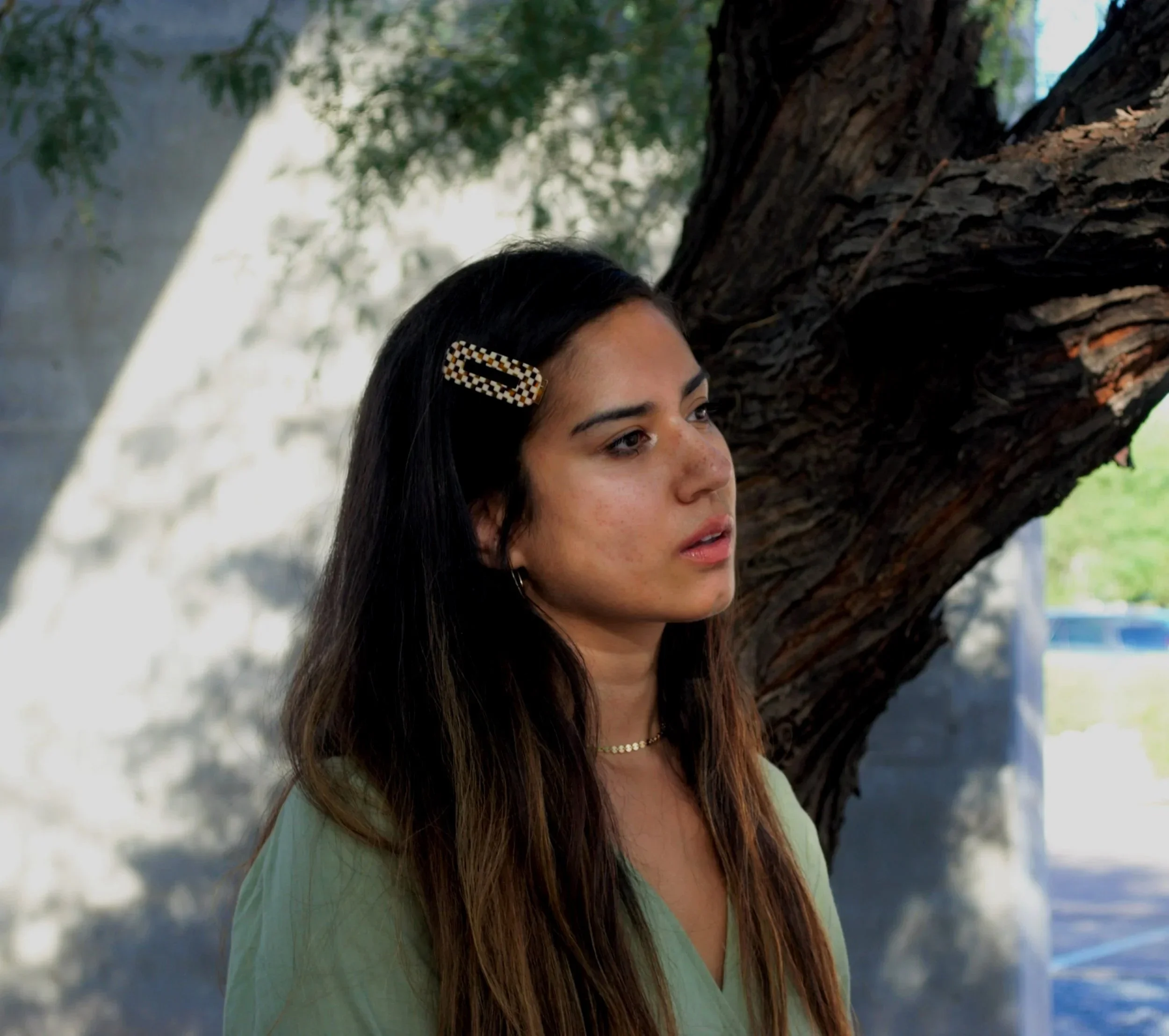
photograph by Nadine Aber
from Vol. 39, Nos. 2 & 3
Aria Aber’s first published book was the poetry collection Hard Damage, released in 2019, the winner of the Prairie Schooner Book Prize in Poetry as well as the Whiting Award. Hard Damage is able to capture, in equal measure, the scent of an azalea bush and the aftereffects of an air strike in Afghanistan—“How much,” the speaker asks in one poem from this collection, “of my yearly tax is spent to bomb the dirt that birthed me?” Aber, the daughter of Afghan refugees, was born in Berlin and now lives and works in the United States. Good Girl (Hogarth, 2025), her latest work, picks up many of the themes of Hard Damage: the legacy of violence, the tensions facing an immigrant family, the ecstatic temptations of beauty and art. As a work of fiction, it expands upon these concerns with novelistic nuance and detail. Nila, Good Girl’s protagonist, is a nineteen-year-old woman living in Berlin, caught between the strictures of her family life and the liberating, sometimes frightening, possibility of reinvention. It’s an electric read, punctuated with descriptions of taking uppers at a techno club and the finer points of film photography, and one that shows Aber to be an equally talented novelist as she is a poet. In the spring of 2025, we connected over email to discuss Good Girl and Aber’s other work.
This conversation has been edited for clarity and brevity.
Boulevard: You’re the first poet we’ve had the honor of interviewing for this series, I think, although of course you’ve recently transitioned to writing fiction as well. What was the process of navigating that shift in genre like?
Aria Aber: The shift was challenging, but it was also extremely rewarding. Because I didn’t have formal training as a fiction writer, I had to teach myself how to write a novel by carefully studying some of my favorite books. I turned to Garth Greenwell, Raven Leilani, Marguerite Duras, James Baldwin, and Jean Rhys. Most of these writers, of course, don’t really write typical plot-heavy novels, but rather character-forward, voice-driven pieces of fiction, which felt appropriate for my own aesthetic preferences. A lot of the mentioned writers also started out as poets or at least have a very poetic sensibility in their work. Their language is meticulous and crystalline, which is something I wanted to foreground in my own novel as well. From them, I learned how to create tension and drama without sacrificing beauty on the more granular levels of sentence, detail, and sound.
Boulevard: A long time ago, you Tweeted something I think about all the time, which was “novel writing really is just ‘I walked there. I sat down. I got up. Then I walked out again. I drove. I took the train. I drank a glass of water. I walked towards him. Then I walked away. I went home. I lay down. I got up. I walked out.’” Do you stand by this?
AA: Of course, writing a novel is much more laborious than just filling in the very material sentences in which one describes how a character moves through space, which is what I wanted to ridicule in the Tweet—but that aspect of novel-writing is the furthest removed from poetry because in a lyric poem, you can leap associatively without having to maintain narrative linearity or logic. So perhaps that part of composing a novel was the biggest challenge on a craft level, even though, at some point, you create a subconscious rhythm wherein you know which details to include, and which ones you need to leave out for the storyline to be coherent and propulsive at the same time.
Boulevard: Structure, or form, is obviously a key element of poetry, and of your poems, like those in Hard Damage, your 2019 collection. I’m thinking of the couplets of “First Snow,” or the way that, in “Catalogue of Grief,” your poem after Carolyn Forché, the lines proceed in alphabetical order. Did structure inform your writing of the novel in similar, different ways?
AA: Structure was equally as important, even though Good Girl doesn’t adhere to the same tight formal constraints as my poems. I did, however, know that I wanted the book to be a bildungsroman, i.e., for the narrative to follow a young protagonist on her journey to adulthood, and for the book to begin at a point of retrospection. This was a formal choice I made in order to explain the lush and occasionally elevated language, which didn’t feel entirely authentic to how I imagined a 19-year-old would express themselves. The main the narrative is set around 2010–2012, but there are flashback chapters which focus on my protagonist Nila’s childhood and earlier teenage years. Those usually occur when there is a point of conflict in the present-day story when Nila experiences a feeling of shame or inadequacy, which leads her to slow down and reflect on past experiences and how those might explain or contradict her behavior as a nineteen-year-old. So, I was very conscious of when and how to include the “background” information, and I consider them “lyrical interjections,” similar to formal or temporal leaps in a poem.
Boulevard: Your writing is charged by both great beauty and great violence. “Beauty and Terror,” as Rilke says, and as you quote in more than one of your poems. Reading Good Girl, these extremities are certainly at work, and I was intrigued by the inclusion of scenes of a more banal kind of ugliness, like narrator Nila’s descriptions of her family apartment. Do you have any thoughts on the function of these forces in your work, or in literature more broadly?
AA: In my writing, regardless of genre, I am always interested in extremes, opposites, binaries. I am invested in exploring the dialectical tension between two opposites or opposing poles––be they geographic, aesthetic, moral, or emotional. Beauty and terror are two of those opposites, but so are progression and tradition, riots and state-sanctioned power, youth and old age. And as Good Girl is thematically focused on illuminating the underworld and parallel societies of Berlin, it only felt natural to me to write about ugliness, dirt, and filth. Aesthetically, I’m fascinated by rot and what a close-up of rot, or dirt, might reveal in terms of meaning. We live in a time of severe moral and political contradictions, where most people in the global north are living in a sanitized version of reality that is utterly desensitized to the suffering of the global south. By paying attention to the rot underneath our lives, I hope to draw attention to the material and psychic conflicts of people who live in Western cities and are still disenfranchised.
Boulevard: You’ve spoken about your intention, in writing the relationship between Nila and her older lover, Marlowe, to give it nuance, to make it something that can’t be reduced entirely to the model of predator/victim. In that exploration of agency, their affair reminded me of the similar one between Katharina and Hans in Jenny Erpenbeck’s novel Kairos (New Directions, 2024), which also takes place in Berlin, or even of the coupling of Ivan and Margaret in Sally Rooney’s Intermezzo (Farrar, Straus and Giroux, 2024). I think we’re at an interesting and potentially exciting place when it comes to the artistic depiction of these difficult, very human entanglements between people in different phases of their lives—how do you see Good Girl working through that? Are there ways you felt you needed to be careful, in bringing to life this destructive passion?
AA: I still haven’t read Intermezzo, but I did read Kairos recently and immensely enjoyed it. In Kairos, especially, the relationship between Katharina and Hans is set at a different time, where age-gap relationships were not as frowned upon—and their age gap is of course much more excessive, considering that he is in his fifties, and she is nineteen. In Good Girl, the violence that’s depicted is not just romantic or domestic but also functions on a national and political level. There’s the violence of war, which creates refugees in exile; there’s the violence of the neo-Nazi terror organization, which murders innocent business owners; and there’s the familial violence in Nila’s Gropiusstadt community where domestic violence is used as an inherited language of discipline because it provides the adults with a sense of agency in a chaotic and alienated life. Nila believes that by choosing the relationship with Marlowe, she can transform the violent pressures of her life into something she has control over, but of course, it’s not that simple and their erotic game quickly deteriorates. Although it was important to me to portray the nuances of the relationship between Nila and Marlowe in Good Girl and highlight their moments of genuine connection, there is also a real danger in the romance. He becomes abusive. He is drawn to her because she is malleable, and he can tell that she has little to no boundaries when it comes to her own safety and integrity.
Boulevard: Another comment you made elsewhere, in Interview, is that in writing Good Girl you “did want to write something that’s readable.” That stuck out to me because I feel it’s a sentiment I don’t often hear from authors and sometimes wish I would. Perhaps there’s a stigma to “readability,” some notion that it’s anti-intellectual, or somehow selling out? What is your interest in being readable?
AA: If I remember correctly, that comment came at a moment when we spoke about the difference between what would be considered a “poet’s novel” vs. a “normal novel” or a “novelist’s novel.” I don’t really believe in these harsh demarcations, but I think what I wanted to point out is that I really love novels because of their readability. I love reading a good story, listening to it, or telling it. I don’t think of it as “selling out” but just as what makes sense to each writer aesthetically. I enjoy novels that are more experimental and don’t adhere to a linear narrative as much as a traditional novel, but I felt compelled to undertake the challenge of creating a classic Aristotelean narrative with a beginning, a middle, and an end. In terms of craft, I thought of it as maintaining a sense of control over what feels like a fragmentary life torn apart by geographic and linguistic lacunae, such as the exilic existence of the characters in Good Girl.
Boulevard: When Nila goes to the Bunker, the techno club in your novel that’s a stand-in for Berghain, she describes the bouncers at the door as “Cyclopes.” It’s a reference that serves as the title of one of my favorite poems in Hard Damage, a section of the longer sequence “Operation Cyclone,” and that returns in “Operation Cyclone, Years Later” in the lines “a cyclone is not a cyclops / although it too has an eye— / it can see. But would it testify?” More subtly, too, I find the presence of the Cyclops in your poem “Rilke and I,” in passages like “Ich. Ich: far from Auge, the eye. Sounds like licht, which is light, or / dight, which is dense—I, the dense light of my eyeball that strives to look forward only.” The figure of the one-eyed creature seems to resonate in some ways with the figure of the literary narrator, the reader, the political subject—what do you see as the significance of its recurrence in your work?
AA: I love this question and how you draw a comparison between the cyclops in Hard Damage and the cyclopes in Good Girl. That parallel was intuitive and not something I thought about, consciously; it’s hard to define a clear connection between the way the metaphor works in the two books now without sounding esoteric. In Hard Damage, the cyclops emerges as a mythical figure in relation to the CIA operation titled “Operation Cyclone”, which led to the destabilization of Afghanistan and the political vacuum which allowed the eventual rise of the Taliban as we know it. I was primarily interested in the cyclops for its etymological connection to the word cyclone. Then, I went on to write through the Greek myths to interrogate and problematize the mythification of foreign policy and warfare. In Homeric mythology, the cyclopes are defined as savage, uncivilized, and hostile creatures, not so dissimilar from how Afghans are portrayed in the Western imagination, especially in the 19th and 20th centuries. But I absolutely adore the idea of the “one-eyed creature” as literary narrator––as camera, as lens, as subject, which documents and refracts reality. I am obsessed with the types of creatures that are seen as monstrous or ungovernable because I believe there is political power inherent in the individual who is seen as “uncivilized,” “savage,” or “backwards” ––what kind of potential do such creatures possess in a post-humanist framework? What can we learn from them in terms of riot and revolution? These are all questions which I like to think through in my writing.
Boulevard: Music features heavily in Good Girl. Are there certain songs, albums that acted as touchstones for you while you were writing the book?
AA: I don’t usually listen to music while I write, but I did listen to a lot of music to get myself into the mood and atmosphere of the book’s setting. Nicolas Jaar and Pachanga Boys were important, as well as some classic Persian songs by artists such as Ahmad Zahir and Googoosh.
Boulevard: Do you remember the first piece of art you fell in love with?
AA: It was probably a book by Franz Kafka, or the film Daisies by Vera Chytilova. More recently, it’s been the novel Woman at Point Zero (Bloomsbury Academic, 2024) by Nawal El Saadawi. It absolutely took my breath away; it’s a novelistic masterpiece and very important. I can’t wait to teach it.
Boulevard: In addition to working as a writer, you’ve also been an editor at more than one literary magazine: the short-lived Astra, and, more recently, The Yale Review. Do you see a relationship between that work and your own craft? What do you learn, acting as an editor?
AA: My work as an editor is some of the most rewarding work I do, and I feel grateful for it every day. In fact, I think if I weren’t a writer, I’d probably be an editor full-time. It’s important to me not just for the curational aspect of comprising a diverse group of poems and sharing them with the world, but also for the ability to see connections across various literary traditions. I often publish poems in translation and older work in conversation with newer pieces. I also enjoy editing friends’ manuscripts and helping them think through challenges in ordering/sequencing their work. When editing, I automatically see things that work vs. don’t work, and it’s helpful, even on a selfish level, to employ those strategies in my own writing. It’s easier, after all, to see other people’s work than your own.
Boulevard: Is there something you hope to accomplish in your career to come, creatively or otherwise?
AA: Apart from growing as a writer myself, I hope to use my platform to amplify and support younger, and underrepresented, or forgotten writers.
Aria Aber was born and raised in Germany and now lives in the United States. Her debut poetry collection, Hard Damage, won the Prairie Schooner Book Prize and the Whiting Award. She is a former Wallace Stegner Fellow at Stanford and graduate student at USC, and her writing has appeared in The New Yorker, New Republic, The Yale Review, Granta, and elsewhere. Raised speaking Farsi and German, she writes in her third language, English. She recently joined the faculty of the University of Vermont as an assistant professor of creative writing and divides her time between Vermont and Brooklyn.